Review
Custom Wallets in MetaMask: Risks and Setup Review
You open MetaMask to send funds, and you notice several accounts with similar names, plus a network you added months ago and barely remember. I have seen that exact moment turn into panic, so I start with the simple truth: custom wallets give you flexibility, but they also give you more ways to make a costly mistake.
In short
- Custom wallets suit users who need separate accounts or added networks, but they require careful labeling and backup discipline.
- MetaMask supports Hundreds of thousands of tokens, so asset confusion is a real risk when token names or networks look similar.
- MetaMask lists Chrome, Firefox, Brave, Edge, Opera, iOS, Android, Web, and each device you use should be treated as a separate security surface.
- Multi-account wallet security depends on protecting the recovery method, checking permissions, and keeping high-value funds away from daily-use accounts.
Key facts
| MetaMask | |
|---|---|
| Supported coins & networks | Number of supported assets: Hundreds of thousands of tokens |
| Devices & platforms | Platforms: Chrome, Firefox, Brave, Edge, Opera, iOS, Android, Web |
| Price | — |
| Who controls the keys | — |
What are custom wallets, and who do they suit?
The risk in plain words is this: a custom wallet setup can make one wallet feel like many separate vaults, but the same recovery method may still control the accounts underneath. If that recovery method is exposed, every related account can be at risk.
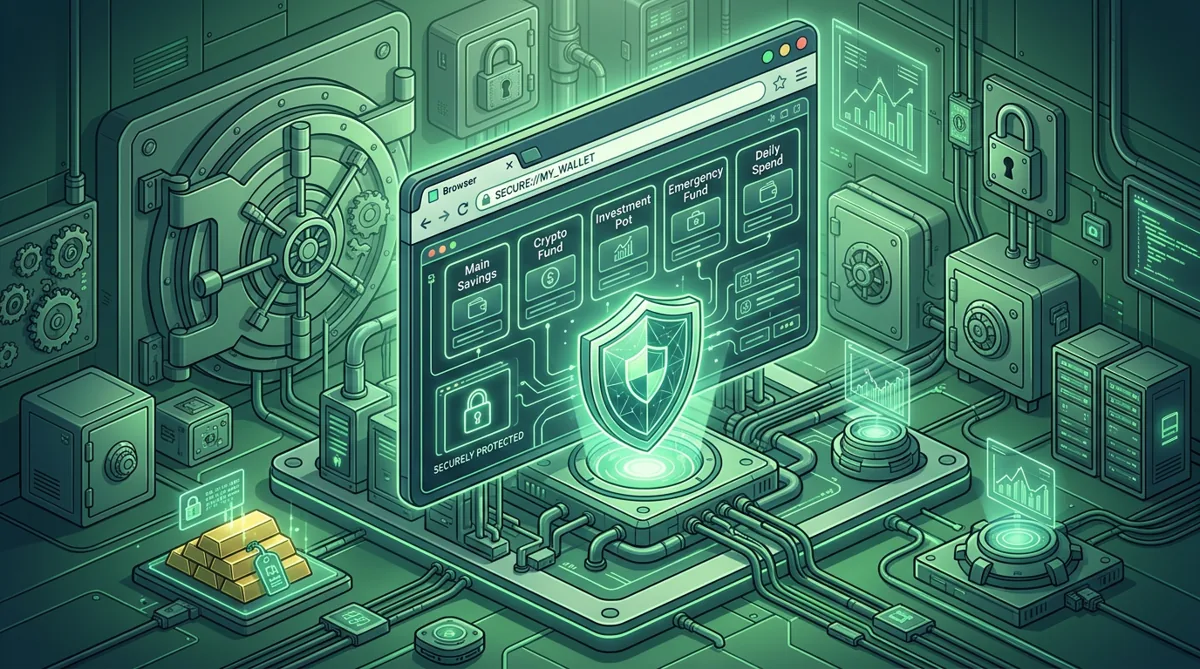
When I say custom wallets, I mean a MetaMask setup you personalize beyond the default account. That may mean adding accounts, naming them by purpose, adding networks, importing an account, connecting to sites, or separating daily activity from longer-term storage. Some users search for terms like lv multiple wallet, mk wallet, or code wallets when they are really trying to understand account separation or custom account labels. I treat those labels as prompts to ask a safer question: what controls the funds, and what happens if that control is exposed?
MetaMask suits people who want a flexible browser or mobile wallet for regular on-chain activity. It is useful for testing small transactions, managing separate account names, and interacting with apps. If you are comparing custody choices, I recommend starting with Self-Custody and Custodial Wallets Explained so the responsibility is clear before you move funds.
What worries me is false comfort. If every account sits under the same exposed recovery method, account labels do not protect you. Labels help you avoid mistakes; they do not replace key security.
Which coins, tokens, and networks can custom wallets handle?
MetaMask supports Hundreds of thousands of tokens. That range is powerful, but it also creates room for confusion. In incident response, I often see losses begin with a rushed assumption: the user sees a familiar token name, signs a prompt, or sends on a network that looks close enough.
The safer way to think about assets is by network first, token second, and account third. If a token appears missing, it may be on a different network, hidden from view, or connected to an account you are not currently viewing. That does not mean you should start approving prompts or importing random settings.
For custom wallets, I suggest naming accounts by job, not by emotion. Names like spending, receiving, testing, or cold-transfer-prep are clearer than lucky names or vague project names. If you manage many tokens, keep a private inventory that records which network and account you intended to use, without writing private keys or recovery words into that inventory.
Warning: Sending funds on the wrong network, approving the wrong token permission, or moving assets from the wrong account can lead to permanent loss. When the wallet screen feels confusing, do not sign first and investigate later.
If you need a refresher before adjusting assets, read Wallet Basics for Safer Crypto Storage. The goal is to build a habit of checking context before you approve anything.
Where can you use MetaMask custom wallets?
MetaMask lists Chrome, Firefox, Brave, Edge, Opera, iOS, Android, Web. I treat every platform as its own risk area. A browser extension on a work laptop, a mobile wallet on a phone, and a web session on a shared machine do not carry the same exposure.
MetaMask is convenient because it follows users across common browsers and mobile devices. That convenience is also why criminals target the moments around signing, approvals, fake support, and device compromise. A custom setup with multiple accounts can reduce some day-to-day exposure, but only if you avoid connecting every account to every site.
For multi-account wallet security, I prefer a simple rule: the account that browses unknown apps should not be the account that stores meaningful value. If you use a browser wallet often, keep the device clean, update through official channels, and review extensions. If you suspect malware or browser tampering, pause wallet activity and work through a device safety checklist such as Crypto Home Security Checklist: Virus Checker Basics.
A hardware wallet can improve separation when used correctly, especially for funds you do not need to move often. I cover that distinction more generally in Self-Custody and Hardware Wallets for Safer Storage.
How do backup and recovery work for custom wallets?
The backup model is the part I want readers to respect most. In self-custody, recovery usually depends on a secret recovery method represented by a list of words or a private key. I am describing that generically on purpose, because no safe guide should publish examples or ask you to type those secrets into a website.
A custom wallet with several accounts may still depend on one underlying recovery method. Imported accounts can have their own separate control material. If you assume everything is covered by one backup when it is not, you may lose access later. If you assume accounts are separate when they are actually controlled together, you may underestimate the impact of exposure.
Use this setup process when creating or reorganizing custom wallets:
- Step one: Decide the purpose of each account before moving funds.
- Step two: Create or select the account inside MetaMask, then rename it immediately.
- Step three: Confirm which recovery method controls the account. Do not reveal it, photograph it, paste it into chats, or store it in cloud notes.
- Step four: Add only the networks you actually use.
- Step five: Test with a small transfer when the destination, network, and account history are all clear to you.
- Step six: Review site connections and token approvals after activity, especially if you were exploring unfamiliar apps.
- Step seven: Keep a written recovery plan that tells your future self where backups are stored and what each account is for, without exposing the secret itself.
The why behind these steps is simple: most wallet disasters I help untangle are ordinary human moments under pressure. A person is tired, a prompt appears, the account name is unclear, and the wrong approval goes through.
For a practical self-custody routine, use Key management checklist for safer self-custody. If you already exposed keys or lost access to a recovery method, stop moving funds randomly and follow a containment plan such as Lost Seed or Exposed Keys: Cold Wallet Crypto Checklist. For longer-term planning, I also like Cold Storage Best Practices for Safer Recovery.
Are custom wallets in MetaMask worth using?
My verdict is yes, with boundaries. Custom wallets are useful when you need account separation, cleaner records, and a way to keep risky browsing away from more important funds. They are not a substitute for careful recovery storage, device security, or permission review.
The strongest use case is a user who understands self-custody and wants better organization. The weakest use case is someone who adds networks and accounts quickly because a stranger, fake support agent, or urgent message told them to do it. If a setup instruction arrives with pressure, secrecy, or a demand to reveal recovery information, I treat that as hostile.
I would use MetaMask custom accounts for low-friction activity, testing, and limited exposure. I would not rely on account labels alone to protect meaningful savings. For that, I prefer stronger separation, a calmer signing process, and recovery planning that another trusted person could understand in an emergency without seeing the secret words.
The protective habit is to pause before every approval and ask: which account is active, which network is active, what permission is being requested, and what could move if I am wrong?
Questions and answers
- Are custom wallets the same as having separate wallets?
Not always. Several accounts may be controlled by the same recovery method, while an imported account may have separate control material. I check what controls each account before treating it as separate.
- Is a multi-account wallet safer than one account?
It can be safer for organization and exposure control, but only if you separate purposes and limit connections. If the same recovery method is exposed, all related accounts may be at risk.
- Should I use MetaMask for long-term storage?
I prefer using MetaMask for active tasks and keeping meaningful long-term funds behind stronger separation, often with hardware wallet planning and a written recovery process.
- What should I do before adding a custom network or token?
Confirm why you need it, check that you are in the right account, and avoid signing prompts you do not understand. If you feel rushed, close the session and review later.
- What if I think my recovery method was exposed?
Stop using that wallet for new deposits, avoid asking strangers for live help, and move through a calm containment checklist from a trusted guide. Random hurried transfers can make the damage worse.